

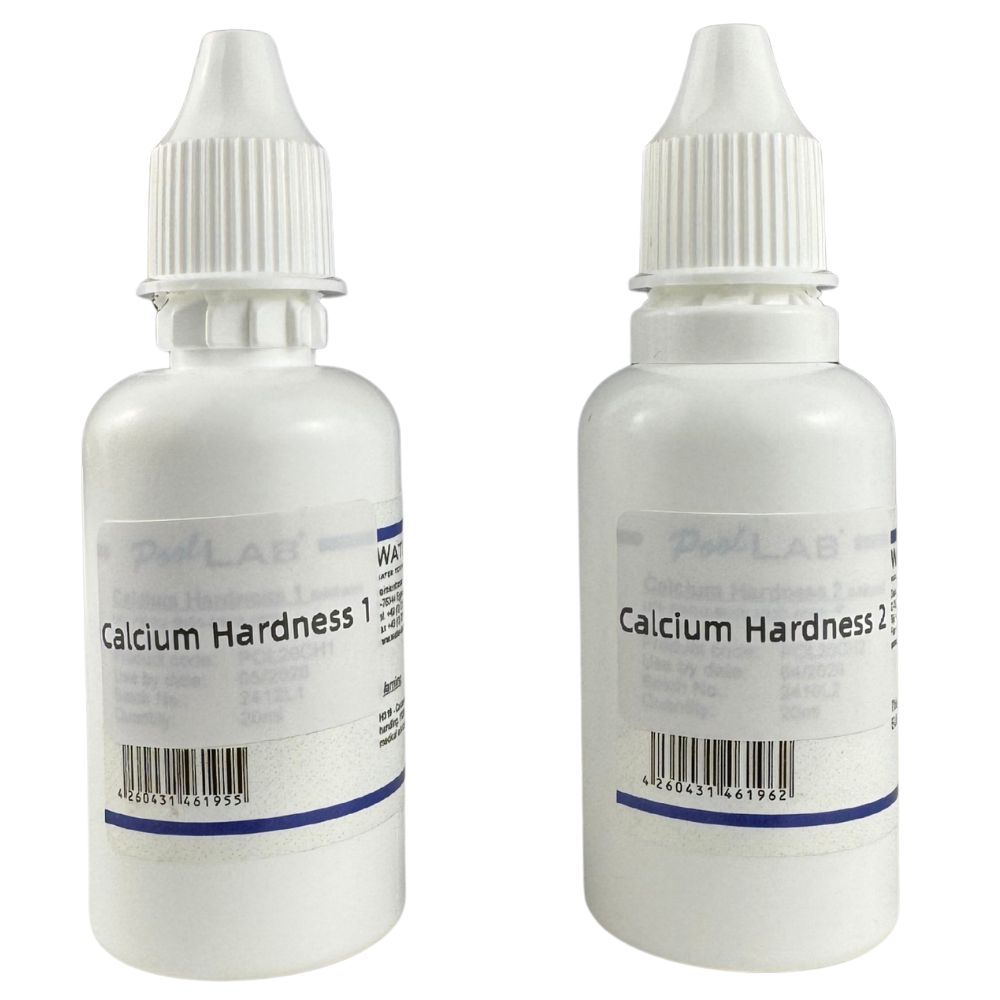
Calcium Hardness Liquid Reagents
Calcium Hardness Liquid Reagents
- Made in Germany for the US market
- Item is located in the USA and ships from the USA. Orders ship within 24 hours. Free shipping on orders over $100. To find out the cost of worldwide shipping, simply add items to your cart and enter your shipping details — the rate will be calculated automatically
Couldn't load pickup availability
Which photometers are these reagents compatible with
Which photometers are these reagents compatible with
The reagents are compatible with our entire family of photometers
- PoolWaterLAB v2.0
- PrimeLab v2.0
- PrimeLab v1.0
- PoolLab 1.0
- PoolLab 2.0
Calcium Hardness Liquid Reagents – Kit to Measure – 50 Tests are photometer-compatible replacement / refill consumable liquid reagents used for accurate pool & spa testing.
Key Specs
- Product type: Replacement / refill reagent (consumable)
- Test parameter: Calcium hardness
- Format: Liquid reagent kit (50 tests)
- Shelf life: 6 months (from the date you receive it)
What this reagent does
Basically dissolved salts belonging to the alkaline earth elements calcium and magnesium are found in non-distilled water. In rare cases, strontium and barium can also be found. These combine with carbonate ions to form water- insoluble compounds (calcium). Through the total hardness measurement, the potential danger of calcium precipitation is measured as the required carbonate ions form from hydrogen carbonate ions when water heats up or when there are pH values that are greater than 8.2 (comp. Alkalinity). When measuring calcium hardness (SVZ1300 tablet process), only the part of the dissolved calcium in water is measured. The amount of magnesium dissolved in water is determined from the difference between the measurement and the total hardness.
Storage & shelf life
Store reagents cool, dry, and sealed. Avoid humidity and heat.
- Recommended storage temperature: 59-77°F (15-25°C)
- Protect from: moisture/water and direct heat
Proper storage helps maintain accuracy and supports the stated shelf life.
Material Safety Data Sheet (MSDS) — Download
Note: Product performance depends on correct testing procedure and proper reagent storage.
Share
-
Cyanuric Acid (CYA) in Pools: Safe Levels, Hidd...
Cyanuric Acid (CYA) protects chlorine from sunlight, but high CYA can make chlorine far less effective. Learn the ideal CYA range, warning signs of high levels, and how to test...
Cyanuric Acid (CYA) in Pools: Safe Levels, Hidd...
Cyanuric Acid (CYA) protects chlorine from sunlight, but high CYA can make chlorine far less effective. Learn the ideal CYA range, warning signs of high levels, and how to test...
-
Why 97% of Pool Chlorine Can Be Inactive (Free ...
High CYA can make chlorine far less effective—even when tests look normal. Learn the FC/CYA relationship, the 7.5% rule, and how to keep your pool truly sanitary.
Why 97% of Pool Chlorine Can Be Inactive (Free ...
High CYA can make chlorine far less effective—even when tests look normal. Learn the FC/CYA relationship, the 7.5% rule, and how to keep your pool truly sanitary.
-
Why Pool Test Strips Fail When Cyanuric Acid Is...
Test strips often look “fine” even when your pool isn’t truly sanitized—especially with high CYA. Learn why strips fail, what they miss, and how to test accurately.
Why Pool Test Strips Fail When Cyanuric Acid Is...
Test strips often look “fine” even when your pool isn’t truly sanitized—especially with high CYA. Learn why strips fail, what they miss, and how to test accurately.
-
The Only Reliable Way to Balance Cyanuric Acid ...
Balancing CYA and free chlorine is the key to clear, safe pool water. Follow a simple step-by-step method to set the right FC level based on your CYA.
The Only Reliable Way to Balance Cyanuric Acid ...
Balancing CYA and free chlorine is the key to clear, safe pool water. Follow a simple step-by-step method to set the right FC level based on your CYA.
- Choosing a selection results in a full page refresh.
- Opens in a new window.